Packing, Packing, Packed.

I’m surrounded by a strange juxtaposition today. Outside there are big soft flakes of snow falling slowly to the ground. They settle atop the spruces and cover the boot prints in the old snow. The temperature is 7 degrees here at my cabin, and I’ve spent the past day or so packing for river trip. Dry bags, pelican cases, wetsuits, sleeping bags, and life jackets have been folded, stuffed, packed, unpacked, repacked. Now, stacked in an all-too big pile near the front door are a camera case holding the photographic gear for the trip: 1 body, 17-40f4L, 70-200f2.8L, 1.4TC, 1 flash, an ultralight tripod, and assorted CF cards, gels, batteries, and other accessories. All of that stuff will be transferred over to the Pelican case once I hit the river. The duffel holds clothes, dry bag, life jacket, safety gear, sleeping bag and the rest of my personal gear. So I think I’m ready for the Grand Canyon.

Have I mentioned that yet? I’m going down the Grand Canyon. My friend Hugh Rose (http://www.hughrosephotography.com), drew a personal permit for the canyon this year, and I managed to wrangle my Dad and I slots on the trip. So we’ll be joining Hugh, Patrick Endres (www.alaskaphotographics.com) and a group of other folks for the trip. Hugh and part of the group are already on the river, they started a few days ago at Lee’s Ferry. My Dad, another rafter, and I will be hiking down the Bright Angel Trail from the South Rim on the 27th to rendezvous with the group at Phantom Ranch. From there we will spend 18 days floating down the Colorado, through the biggest of the canyon’s rapids, and out to Pearce Ferry at the head of Lake Mead.

As you might expect, I’m excited about it, but it isn’t quite real yet. Fortunately, that is about to change.

More Aurora: It just keeps coming.

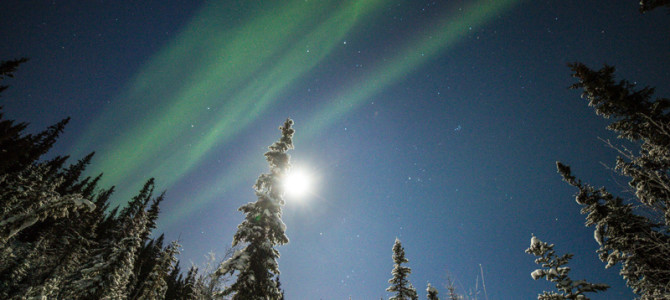
After a brutally cold January, winter has redeemed itself with a sublime, sunny, and clear-skied February. Temperatures have barely snuck below zero for three weeks now, and even better the aurora has been hopping. It got going early on Saturday night. I first noticed it when I was walking the dog and saw some hazy green curtains visible in the blue light of late evening. Within an hour the display had expanded to multiple, bright curtains directly overhead. It didn’t last too long, but it was great while it did. Over the next year or so, it should just be getting better. Long-term solar forecasts indicate that sun spot, flares and other solar storms are on the increase. All that means more particles shooting out of the sun toward earth, which in turn, generate the aurora. Go storms!

Valentine’s Aurora

About 10pm last the night the Aurora decided to have a burst of activity. The first show didn’t last long, no more than 20 minutes, but it was fast moving with waves rolling through the curtains of light. Even better, it was warm out, nearly 20 degrees here at my cabin, and  it was no hardship to stand out and watch the display. As quickly as it arrived the lights faded into a green haze that covered most of the sky, and I went to bed.

February Desktop

Wow, I haven’t been posting and I’m late on the February Desktop… Sorry about that, I’ll try to rectify that in the near future. Here’s the image, click for a larger version, then feel free to click on it for a larger version. Personal use only.

Blue Hour

Image


The Blue Hour is the all too short period of time between when the sun disappears behind the horizon and the arrival of night. The evening sky takes on its richest color during this time, and the tones are in constant flux as they deepen toward black. While I’ve shot during this time of day many times before, those efforts have almost always come just after I’ve been photographing the sunset, or evening light. Blue Hour images have always been incidental, rather than purposeful.

On clear blue days here in Colorado, the high altitude sky acquires a rich, deep color, that very quickly sheds the remnant colors of sunset. I’ve been admiring those colors and last night finally got out for a short walk with the camera to make a few images. The main problem I found is adding interest to the foreground. The sky is by far the brightest thing out there, and the foreground elements will quickly move toward silhouette, which is fine if that is what you are aiming for. I wasn’t, so I used an off-camera flash, gelled with a full cut of CTO to highlight some foreground elements in many of the images. I set the camera to a timer and aimed the flash by hand. I also made one black and white conversion (two images down), as an experiment.

On this New Year’s Eve, I wish you all a creative, safe and adventure-filled 2012. Happy New Year!

All of these images and others from the shoot are available as prints and digital downloads on my stock site right here.


My Favorite 6 Images of 2011: Part 2

Image

This post is the second and final part of my contribution to 2011 retrospective pieces. (See Part 1 here.) As I sorted through my images from the year, I realized that I was surprisingly unproductive. All three of these next images were made on the same trip, suggesting I didn’t get out nearly enough. So here is my New Year’s Resolution: Photograph more, lots more. Cheers!

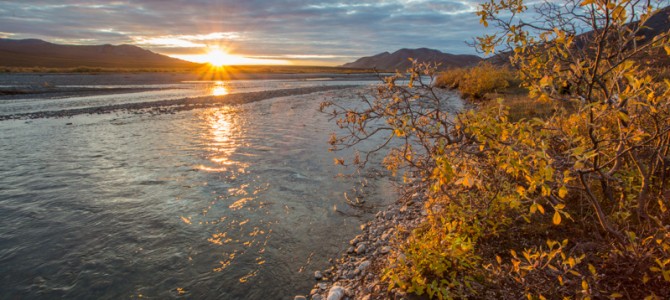
During early August I led a spectacular trip down the Noatak River in the Brooks Range of northern Alaska. The Noatak is a west-flowing river, dropping out of the western portion of Gates of the Arctic National Park, through the wild and remote Noatak National Preserve and then finally out into the north Pacific near the village of Kotzebue. We floated the upper portion, from the point where there was just enough water to paddle the canoes to right around the border between the park and the national preserve. I was co-leading the trip with my friend Garrett, another Arctic Wild guide. This was one of those trips where everything just went right. The clients were the most enthusiastic, best-humored people I’ve ever had the pleasure of taking out into Alaska’s wilderness, the weather was perfect, and I mean perfect. We felt hardly a drop of rain in ten days on the river. It was as though there were a bubble around us that just didn’t allow us to get wet. Storms would roll up the valley, and I’d feel that for sure, this time, we’d get drenched, but the squalls would pass us by, or peter out before they reached us. More than once, we took hikes up on the nearby ridges just to look down and watch our tents being soaked by a passing shower, but by the time we made it back to camp it was sunny, with only the water droplets on the flies of tents to betray the rain. It was eery, and remarkable.

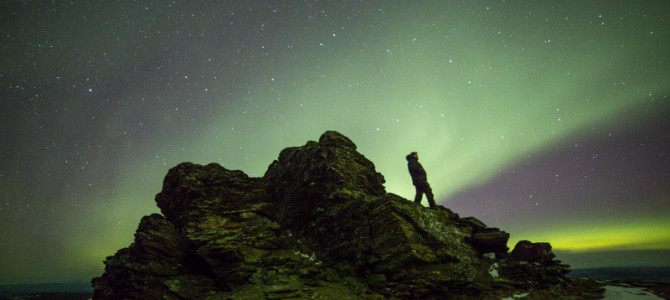
Stone Monolith above Noatak River, Brooks Range, Alaska (Top Image)

The top image I made our first night on the river. We’d been flown into a tiny gravel bar, barely long enough to accomodate the DeHaviland Beaver that carried us from Coldfoot. We paddled a short distance and set up camp on a lovely riverside bar where a tiny, clear stream, trickled down from the drainage above. After dinner we walked up the slope and onto the steeper terrain of a nearby mountain. We climbed steadily. Near a saddle, within moments of the sun disappearing behind the mountains, we found these strange pieces of granite that had been forced out of the tundra by the freezing and thawing of the earth. This particular rock was fifteen feet high and nearly vertical. Other smaller stones were scattered around this patch of tundra like stone chess-pieces, but none quite so grand as this. I had just moments to compose a few images before the sun slipped behind the ridge. While I like this image a lot, I wish I’d had a few more minutes to work. I’d have gotten lower, found some more foreground elements, stepped back and gone wider… Ahh well, it’s the memory of that glorious evening that makes this image one of my favorites of the year. (Canon 7D, 17-40 f4L, handheld).

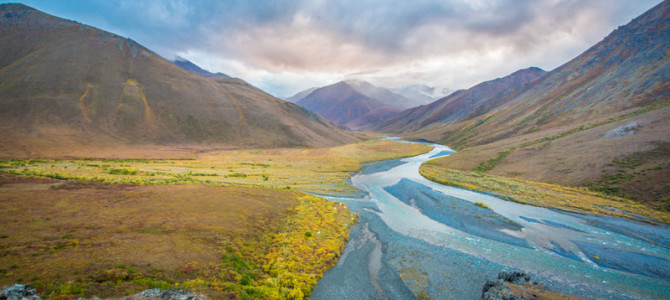
Coming Storm, Kugrak River valley, Gates of the Arctic National Park, Alaska

I made this image on a long day hike up the Kugrak River (a tributary to the Noatak) from our camp along the main stem. We stayed three nights at the mouth of the Kugrak. It was a beautiful spot where chum salmon ran up the crystal clear water of the Kugrak and bears appeared, almost constantly on the river’s edge to fish. On this hike we walked up (and across) the Kugrak a few miles to a tundra bench which we followed for another mile or so before dropping back to the gravel of the valley bottom and heading back to camp. The sun came and went during the hike, and squalls of rain rolled up the Noatak, but never touched us. I made this image of three of our group, topping a small rise as an isolated downpour soaked the mountains on the far side of the valley. I like the repetition of curves in this image. There is the small hillock on the right foreground, then an almost identical curve to the dark mountain the background, and then the curve of the rain squall above. (Canon 7D, 17-40 f4L, handheld)

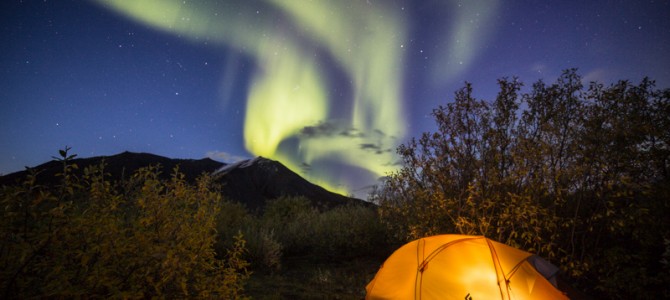
Camp and Kugrak River Valley, Gates of the Arctic National Park, Alaska

On yet another remarkable evening, I made this image of our camp. The Kugrak river valley reaches up into the mountains in the background south of camp while the broad valley of the Noakak stretches out around our tents. I have other similar images where I moved closer to the tents, but I like this one better because it shows, at least in part, how small our little camp was in this vast space. The arctic has spectacular light, which lingers on the mountains for what seems to be hours. As I look at this image, I’m already looking forward to summer, and the glorious Brooks Range evening sun. Can’t wait to get back.. (Canon 7D, 17-40 f4L IS, handheld).

Today and tomorrow are all that are left of 2011. Still time to create a new favorite image. I’ll let you know if I do.

My favorite 6 Images of 2011- Part 1

Image

Jumping on the end of year retrospective bandwagon, here are my personal 6 favorite images from 2011, and the stories that go with them. These are my favorites for a number of reasons, but it is the memories that go with them that make them special. In no particular order here are the first three:

Sunrise, Grosvenor Lake, Katmai National Park, Alaska (Top Image)

I made this image the first morning of a nine day paddle around the Savonoski Loop in Katmai National Park as I was guiding a trip for Arctic Wild. The trip had started out less than perfectly, as Penn Air, had failed to bring our bags from Anchorage to King Salmon in three consecutive flights. Finally, after a long battle with their customer service people, I was assured that our bags would arrive on the final flight of the day. Surprisingly the bags actually arrived and Katmai Air was gracious enough to squeeze in one more flight to take us out to upper Grosvenor Lake just as night was settling across the park. We scrambled to set up camp in the growing darkness, ate a light dinner and flopped gratefully into our sleeping bags. After too few hours of sleep I woke the next morning and peered out of my tent door to see the lake covered in rising steam, the early morning sun lighting up the water in an orange glow and the glaciers of the distant volcanoes lit up with alpenglow. I rose and grabbed my Canon S95 point and shoot and made a few quick landscapes when I looked up the beach and noticed one of my clients enjoying the view over the lake. Within hours the clear blue skies were gone and the drizzle that would follow us for almost the entire 9 day trip had moved in.

Dwarf Fireweed, Great Kobuk Sand Dunes, Alaska

The Kobuk Sand Dunes are an otherworldly place. A few square miles of the sahara dumped into the middle of the boreal forest north of the Arctic Circle. It is harsh looking landscape, with dunes and desert-like vegetation. The comparatively lush forest surrounding the dunes, makes the contrasts even stranger. I spent a couple of days at the dunes this past July, leading another trip for Arctic Wild. It was a basecamp trip, two night in the dunes, and two nights in Gates of the Arctic National Park. My clients, two couples, were on missions to visit every national park in the country, and for one pair, Kobuk National Park (where the dunes are found) and Gates of the Arctic were the final parks on their list. We spent our one full day in the dunes on a long day hike that carried us 10 or so miles around the central and western part of the dunes. The hiking was exceptional, the night before it rained- hard and long, and the following morning the dunes were packed like concrete. We worked our way along a creek that cuts through the middle of the dunes and then up sandy ridge-lines and down to the western side. I made this image mid-way through the hike. The dunes are surprisingly rich in wildflowers but this bright patch of Dwarf Fireweed, or River Beauty stood out in the otherwise gray and brown landscape. I wanted to emphasize that contrast so I composed the image to include much of the dunes and the dark triangular spruces in the background. This image was shot with my Canon 7D and a Canon 17-40 f4L lens, handheld.

Grass and Sand, Great Kobuk Sand Dunes, Alaska

I made this image the same day as the one above, but later in the hike as the dark clouds grew and threatened. We were rushing back to camp, hoping to avoid the downpour which never actually arrived. Despite the storm-like skies it was nearly dead calm. Often, I make images in color and later convert to black and white as an experiment. But this image I envisioned in black and white. This scene was nearly monochrome in life, the only color the subtle browns of the sand, and the muted greens of the grass. I shot a series, moving steadily closer to the clump of grass. When shooting on and sand or snow, you can’t move forward and then decide it looked better farther back because your footprints will mar the texture of the foreground, so it is important to work only forward. I liked this image the best of the series because I think it accurately portrays the stark, almost barren looking landscape of the dunes. The brooding skies provide another level of texture and mood to the image: cold, foreboding, and bleak. Shot with the Canon 7D and 17-40 f4L, handheld.

Check back soon for my final three favorites.