Argentina’s Ibera Wetlands III: Birds

Southern Lapwing. Normally side-light is ineffective for bird photography, it causes too  much contrast, but this is my favorite image I made of this species. The early morning sunlight was soft enough to permit the unconventional lighting. Canon 5d III, 500mm f4L IS w/ 1.4TC, 1/800th, f5.6, ISO 1600.

About 350 species of birds have been recorded in the Ibera Wetlands. While high by North American standards (downright outstanding if you happen to be from Alaska) it is mediocre when compared to other places in the Neotropics. The advantage, the extraordinary advantage in my opinion, is that unlike many birding hotspots, in the Ibera a great many species are readily seen. In two days of not particularly intensive birding, I managed to tick off 125 species.

From a photographic perspective, its even better. Large, photogenic birds are everywhere: Tiger-herons, Egrets, Cocoi Herons, Wood-rails, Storks, shorebirds, waterfowl, Southern Screamers. These images are just a sampling of the potential. With luck, I’ll return to explore the place further.

Incidentally, I LOVE the Canon 5d III. The high ISO performance is amazing, allowing me to shoot in the early morning hours, long before I could have with my previous equipment.

Rufous-collared Sparrow. This is one of the most common bird species across South America. I love them, they are closely related to White-crowned and Golden-crowned Sparrows of North America. This was a pre-dawn shot, handheld, and is a perfect example of how awesome the 5D III is. Canon 5d III, 500mm f4L IS w/ 1.4TC, 1/40th, f5.6, ISO 1600.

Rufous-bellied Thrush. This is another common species in much of Argentina and shares a genus with the familiar American Robin. The first of the sun was tapping this guy making for some interesting light. Canon 5d III, 500mm f4L IS w/ 1.4TC. 1/40th, f5.6, ISO1600.

Giant Wood-rail. I photographed this guy just feet from the door of our room at the Ecoposada del EsteroCanon 5d III, 500mm f4L IS w/ 1.4TC, 1/3200th, f5.6, ISO 1600.

Juvenile Rufescent Tiger-heron. Another regular in the yard at the Ecoposada. This youngster was there every morning, foraging, or perched nearly still in a low branch of a tree. Canon 5d III, 500mm f4L IS w/ 1.4TC, 1/250th, f5.6 ISO 3200.

Great Egret. Somehow, despite spending a lot of time in this species range, I’d never before photographed a Great Egret. It was worth the wait. This bird foraged closer and closer to where I was sitting just as the first of the morning sun crested the horizon. My timing could not have been better. Canon 5d III, 500mm f4L IS w/ 1.4TC, 1/1600th, f5.6, ISO 1600.

Wood Stork. Ugly or handsome? My personal jury is still out. Canon 5d III, 500mm f4L IS w/ 1.4TC, 1/400th, f5.6, ISO 3200.

Ibera Wetlands II: Critters


A Caiman peers out from the floating vegetation in the Ibera Wetlands of northern Argentina. Canon 5d iii, 500mm f4L IS w/ 1.4xTC, 1/1000th, f5.6, ISO 800, handheld from a boat.

Unquestionably, the Ibera Wetlands are rich in wildlife. But unlike other places I’ve spent time in the Neotropics, where wildlife can be cryptic and difficult to find, in the Ibera the animals are hard to overlook. Capybara, the largest rodents in the world (think huge, semi-aquatic guinea pigs), are absolutely everywhere. Black and Spectacled Caiman nap on the shore or are seen as they raise their reptilian eyes from the water to peer about. Three species of deer graze the shores of the marshes or slip in and out of the shadowed patches of forest.

I didn’t get to explore as thoroughly as I would have liked, as I was restricted by time (always it seems). But there is far more to the Ibera, Giant Anteaters were rumored to patrol a distant part of the preserve, and Maned Wolves, the strange long-legged open-country wolves of South America can also be found, if you have the time, patience and persistence to pursue them. I feel like I’ve barely touched the photographic and natural history potential of the Ibera. Someday, hopefully someday soon, I’ll return and give it another go.

Birds, by the way, warrant a post to themselves, so look for that later this week.

A South American Grey Fox trots across a field in the Ibera Wetlands. This guy had clearly been conditioned to humans (probably through mis-guided feeding). Canon 5diii, 500mm f4L IS w/1.4x TC, 1/2000th, f5.6, ISO1600, handheld.

More misunderstood than sinister, a Black Caiman suns itself on some floating vegetation in the Ibera wetlands. The scaly, reflective skin makes photographing these guys extremely difficult as highlights tend to blow out or shadows sink into black. Shady areas, overcast, or early/late day hours would have made the task easier. Canon 5d III, Canon 500mm f4L IS w/1.4TC, 1/3200th, f5.6 ISO 800, handheld from a boat.

The Wild Imagination Newsletter

In order to keep in touch with my writing/guiding/photography clients, friends, and fans, I’ve decided to create a rare and occasional newsletter. It will be published about 3 or 4 times a year and will include news on recent trips, publications, new images, photo tips and stories. If you’d like to sign up to receive these via email, just send me a note with your email address and I’ll add you to the mailing list. Alternatively you can download or read the current issue right HERE.

The Ibera Wetlands Part I

The Milky way over the Ibera. Canon 5D iii, Canon 17-40 f4L, tripod, f4.0, 30 seconds, ISO 800. Foreground “light painted” with the beam of a headlamp. The stars in the Ibera rivaled anything I’ve seen before.

The border between Argentina and Paraguay is largely divided by the sprawling Rio Parana. It’s water flows a murky brown, strongly reminiscent of its larger neighbor to the north, the Amazon. The flats surrounding the river extend for miles. The riversides on both sides of the border are dotted with small towns and a few decent-sized cities. Boats carry goods, people and cargo. But escape that bustle and head south and things open up and the people are scarce.

We took a bus from the regional hub of Corrientes three hours south to the town of Mercedes. From the bus windows the buildings and homes of the city became more scattered until they disappeared entirely, replaced by the subtely rolling landscape of pastures, forest islands, and wetlands. Birds congregated in the wet areas: three species of storks, herons and egrets, ibises and waterfowl. Cattle wandered the tall grasses or stood belly-deep grazing the floating vegetation of the ponds.

In Mercedes we threw our packs in a 4×4 pickup and were driven up a little-used road that went from good pavement to rutted and pot-holed dirt over the course of its 90 miles. The countryside was more than a little reminiscent of the high plains of Montana with scattered Estancias dotting the otherwise empty grasslands.

We bumped north until, some two hours later, we arrived at the village of Carlos Pellegrini, a gaucho cum tourist town on the edge of the sprawling Ibera Wetlands. The Ibera is an ancient oxbow lake of the of the Rio Parana. Some thousands of years ago the great river flowed past where the town stands, but now it is a lake surrounded by marshes, fens, and scattered pieces of forest.

The wide dirt streets were immaculately clean, the town immediately inviting in the evening light. Our driver dropped us off at the gate of the Ecoposada del Estero where we were greeted by the smiling owners, Estrella and Jose. Before I’d even arrived, I did not want to leave.

The landscape of the Ibera is subtle and difficult to capture photographically. There are no grand mountains, no waterfalls, no cliffs, rocks or tumbling creeks. It is a land of grasses and water, floating vegetation, and low forest. While we were there, the sun and blue sky were relentless, rarely marred by even a passing cloud. And so my images of the landscape are few, and reflect the things that were present in abundance: Water and Sky.

Lily pads float in the dark water of the lagoon. Canon 5d III, Canon 17-40 f4 L @17mm, f5.6, 1/2000th, ISO 800, handheld from a boat, just above water level. 

Sunrise over the Ibera. Canon 5D III, 17-40 f4L @23mm, handheld, f4.0 1/3200th. This was a grab shot while I was photographing birds. In retrospect, I would have adjusted these strange camera settings to increase the depth of field.

Forest patch and lake in the Ibera Wetlands. Canon 5d III, 17-40 f4L @17mm, f7.1, 1/2000th, ISO 800. I was trying to emphasize how dry land feels like a small and unimportant aspect of the landscape. From the lake, the shore line vegetation is just a narrow green strip between blue water and blue sky.


Birds from Salta Province, Argentina

Spot-backed Puffbird, Canon 5D III, Canon 500mm f4L IS w/ 1.4x TC, f5.6, 1/2000th, ISO 1600.

I love birding. I love bird photography. The two do not always go together as easily as one might expect. In fact, I’d say they don’t go together particularly well. I can do half-assed bird photography while I’m birding, but it hard to create my best work. The other way around however, hardly works at all. If I’m trying to make good images of birds, I can’t be birding at the same time. Set ups, searching, and composition take way too much time and mental effort to dedicate any of my limited capacities to searching out new bird species.

This trip, with a few exceptions, I was doing half-assed photography while birding. But the fates smiled on me at least a few times and put me together with good subjects in decent conditions while I had my equipment with me. These five shots are all from around the Finca Santa Anita in Salta Province, Argentina. (I’ll have more bird images from later in the trip in a future post). The farm is surrounded by a mish-mash of semi-tropical habitats of scrubby forest, lake edge, fields, gardens, and hedge-rows. We saw around 80 species in the area without searching too hard. I’d like to return at some point and spend more time working the good pieces of habitat, and exploring further afield. But I could say that of every place we visited this trip, and perhaps every place I’ve ever visited. Perhaps someday I’ll manage to dedicate myself entirely to a place for all the time I want.

Oh, that’s right, I already do, It’s called Alaska. (Poor me.)

Male Saffron Finch. Canon 5d III, 500mm f4L IS w/ 1.4x TC, f5.6, 1/500th, ISO 1600.

Rufous Hornero (This species was abundant just about everywhere we went on the trip). Canon 5d III, Canon 500mm f4L IS w/ 1.4x TC, f5.6, 1/200th, ISO3200.

Male Red-crested Finch, Canon 5DIII, Canon 500mm f4L IS w/ 1.4 TC, f5.6, 1/1600, ISO 1600.

Bay-winged Cowbird, Canon 5d III, Canon 500mm f4L IS w/1.4x TC, f5.6, 1/2500th, ISO 1600.

Tobacco Barn in Black and White

Canon 5d Mark III, Canon 17-40 f4L, handheld, ISO 400

This Tobacco drying barn at the Finca Santa Anita, south of Salta, Argentina dates back to the mid-1800s. It is built from adobe bricks and rough-cut wood beams and stands strong after nearly two centuries of steady use. Inside, though not much tobacco remains, the distinctive smell of the drying leaves hangs thick in the air.

As I made this image, I was thinking about the history of the building, wondering, from its perspective, how much change has happened in the many years since its construction. It occurred to me, that perhaps there wasn’t that much. Horses and carts, while largely replaced by pickups, still do ply the narrow dirt roads around the farm. The nearby farm houses were constructed around the same time as this barn and are still homes to families of farmers. Goats graze the fields, tobacco is still planted and harvested, year after year. In fact, perhaps I was part of the biggest change the barn had experienced. Tourists, few though they may be, have found their way to this farming community. And I suspect, the click of my shutter and glowing digital screen may be the strangest thing this barn has encountered.

Transitioning

Canon 5d Mark III, tripod, 17-40 f4L, f4.0, 5sec, ISO 800.

I always find it difficult to return from a trip abroad. There is something about the jet-lag, the exhaustion from hours of travel, and the return to normal life that always leads to malaise and feeling mentally disjunct. Right now, less than 48 hours since stepping off the plane, the fog has barely lifted. I’m working on the long task of editing, renaming, and filing images. There are thousands to go through, more than half of which are going straight into the trash, while a large proportion of the remainder will end up there eventually as I sort through near-duplicates for the best and delete the rest. It’s a long and tedious process.

Both of these images I made at a small family farm, the Finca Santa Anita, located in a small town about 30 minutes south of Salta, Argentina. These were taken a few minutes apart, the top image of the courtyard and asado (Argentine BBQ) behind the colonial era house. The second image, below, is the front of the house. These were made just as the very last light of the day was fading from the sky.

More images to come, and don’t forget to check in on my Facebook page where I’ve been posting some additional shots.

Canon 5D Mark III, 17-40 f4L, tripod, f4.0, 15sec, ISO 800.

Postcard from Salta, Argentina

We arrived in Salta after a 17 hour bus ride from Medoza, which we reached after an 8 hour bus trip from Santiago. But I’m not looking for sympathy. These are not your Greyhound Motor-coach school of travel. No, these buses are something else entirely. We spent the few extra bucks necessary on the long trip between Mendoza and Salta and bought first classes tickets. The wide, (only three across the bus), leather seats reclined 180 degrees and foot rest rose up to provide support for everything below the knees, essentially converting our seats into small, but comfortable beds. We were served a steak dinner complete with a nice Argentine Malbec before we laid back and slept for a solid eight hours.

Salta is a beautiful colonial city tucked into the forested foothills on the eastern slope of the Andes. Our hotel was located just a block from the main plaza.

I wandered around town early in the evening and photographed the cathedral on the plaza all lit up, and then this morning ventured inside another nearby, where the second shot was made.

We are now settled in for three nights at a Finca about 30 miles south of Salta. More to come.

Gear for 3 weeks in South America

I once watched a photographer in an airport in southern Argentina carrying a camera backpack as big as my trekking pack while simultaneously dragging a wheeled camera case with two over-sized tripods strapped to the outside. He looked like a turtle as he worked his way down the gangway toward the plane.

I never, ever, want to be that guy.

As I was packing yesterday for my trip to South America (on which I leave late, late tonight), I kept packing items, then removing them, reassessing and then packing again. This is trip is a photographic balancing act because there are some limitations:

1. This isn’t strictly a photography trip. Rather it’s a fun trip during which I’ll be doing a lot of photography.

2. The photography is going to be diverse: landscape, cities, portraits, general travel, and (here is the hangup) wildlife.

3. Since we are travelling overland with lots of time on buses, I need to be able to easily handle all my gear without fuss or difficulty. No multiple trips, no shuttling gear. Everything has to get on my back at once.

4. Unlike the guy above, I do not want to be conspicuous. So the dedicated camera bags are staying at home, and everything, including my clothes and other necessities need to fit inside my pack and shoulder bag at any given time.

So I’ve got think like a minimalist. With the diverse photo opportunities I need to be able to cover a variety of situations and I think I can do that with the following gear:

Canon 5d III, 17-40f4 L, 24-105 f4L, 500mm f4L, 1.4 Teleconverter, tripod, 580exII flash, compact softbox, remote flash trigger, and a Canon S95 point and shoot as a backup (which will be my partner’s main camera).

Throw in a few batteries, memory cards, and a polarizer and that’s it. Done. End of list. I’m not even taking a computer. I’m staying connected through my ipad mini on which I’ll be able to download a few choice images, do some basic processing in a diverse little app called “Luminance”, and post images here and on my Facebook Page.

By this time Saturday, I’ll be wandering the streets of Valparaiso, Chile. Look for updates along the way.


Dusk Aurora

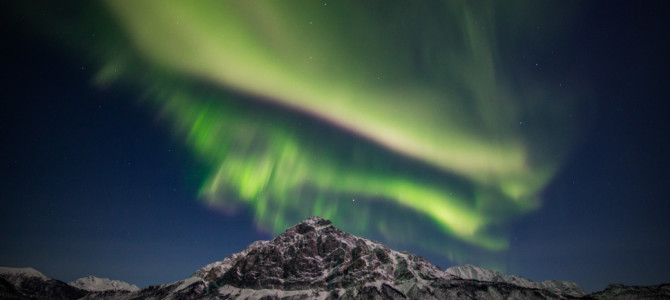
Last night, I stepped outside just before bed. It was 10:00 and still to the west, there was a broad, dusky-blue streak, the last of the lingering day. It’s getting to a point where one has to stay up pretty late to see true night. It’s definitely spring in the interior of Alaska. But I was even more surprised to see a couple of streaks of green hanging in the sky. The Northern Lights had decided to make an early appearance. Bed would have to wait. I grabbed my camera and tripod and headed back out.

I love where I live. Below my small cabin is a creek surrounded by an open wetland about the size of a soccer field. This time of year that wetland is completely covered in ice and snow, but its big and open with views of the surrounding hills. As I travel down to the creek I pass through a few different areas. Around my cabin is a mix of big white spruces and birches. Some of the spruces are nearly 3 feet in diameter and tower over the much smaller birch. Closer to the creek there is an area of open spruce forest with smaller, narrow, 30 or 40 foot tall trees.

The lights weren’t booming as they sometimes do, but they were active and bright green in the dark blue sky. So I played a bit with compositions. I post-holed into the deep snow back in the trees and started experimenting. My favorite is the top image here. To round things out I went down to the open area around the creek and made a few more typical shots.

Let me know what you think. And if you like these, please feel free to use the links below to share on your social media networks. Thanks!